Friday, 18 April 2014

Spring Rolls (vegetarian)

Serves: 4
Cost per person: 1.5 zl (30 UK pence, 50 cent - yo, b**ch, mofo)

Decided to go for rice paper rather than filo for a more authentic SE Asia experience. Lifted the recipe out of the rather bland Vietnamese version into a more vibrant Thai vibe. Spring rolls make a handy snack or accompaniment to a meal - they can be made in advance and then frozen. Just whip them out the freezer and deep fry whenever you fancy - no defrosting required.


In Poland, they call them "Sajgonki" (little Saigons), which is kind of cute...

Anyway, what you need are:

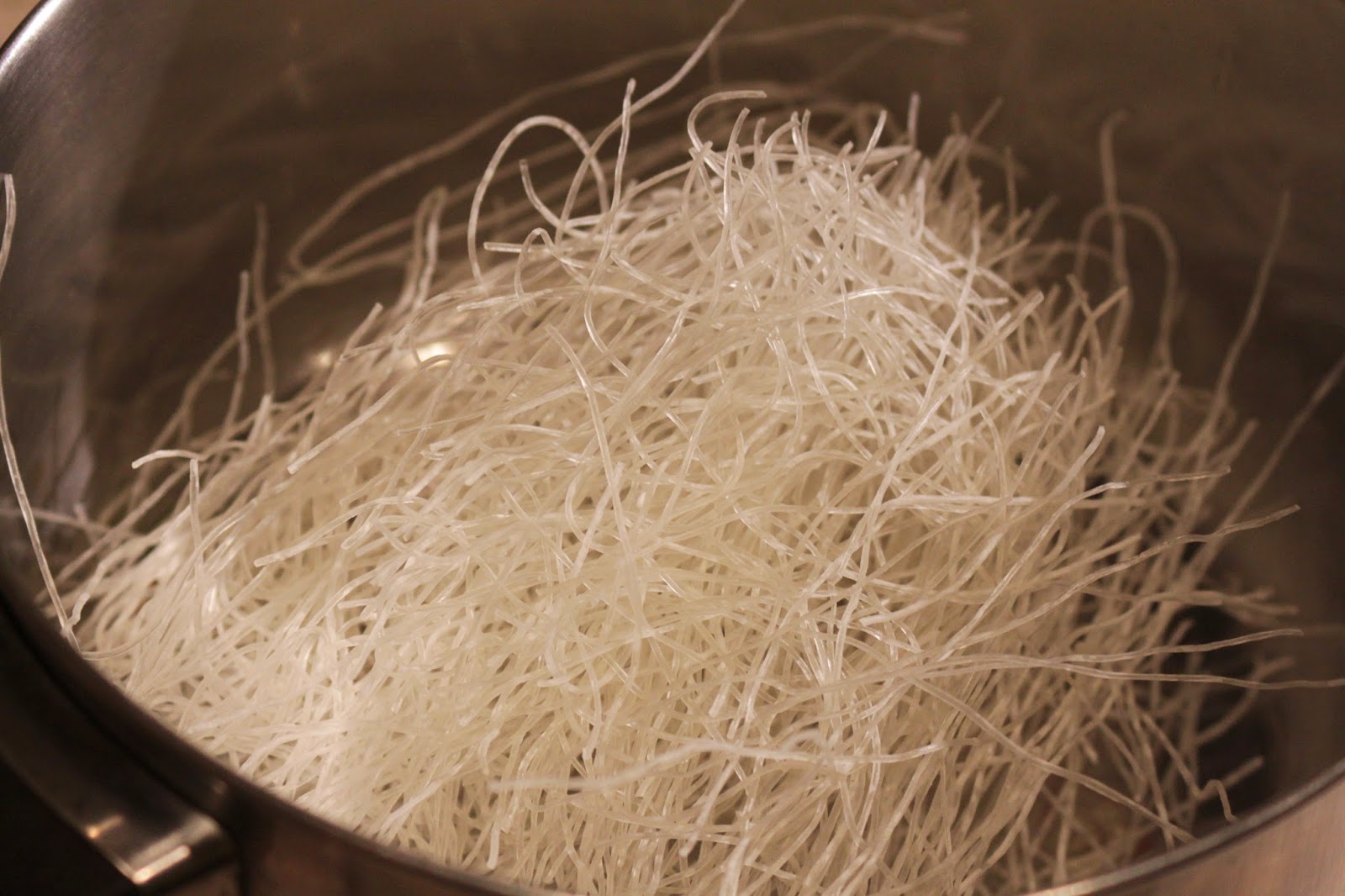
Vermicelli (thin rice noodles)


Some vegetables you happen to have lying around - cut them up finely or grate. Plus, you'll need a good splash of fish sauce, finely chopped chives or spring onion, minced ginger and one finely chopped red chilli for seasoning.


I've used grated carrot and beetroot plus some finely diced red pepper for this version but you could use more or less anything you have lying around in the fridge.


You'll also need some rice paper, which works out very cheap.


Summary of ingredients:

- vermicelli
- rice paper
- mixed veg finely chopped or grated
- 1 tsp minced ginger
- 1 finely chopped red chilli
- 2 tsp finely chopped chives or spring onion
- good splash of fish sauce
- good splash of soy sauce
- good splash of rice vinegar
- 1/2 tsp brown or palm sugar
- 1 sliced green chilli

Let's go!


1. Prep the vegetables as above. Soak the vermicelli in boiled water for around 5 minutes until soft. Drain in a colander. 


2. Mix the vegetables in a bowl with the fish sauce.


3. Now you'll need a tray with some warm water in the bottom. Soak one of the rice papers in there for around 30 seconds until it's soft.


4. Pull the paper out carefully - don't tear! Place flat on a work surface. Add a couple of teaspoons of the veg mix as shown.
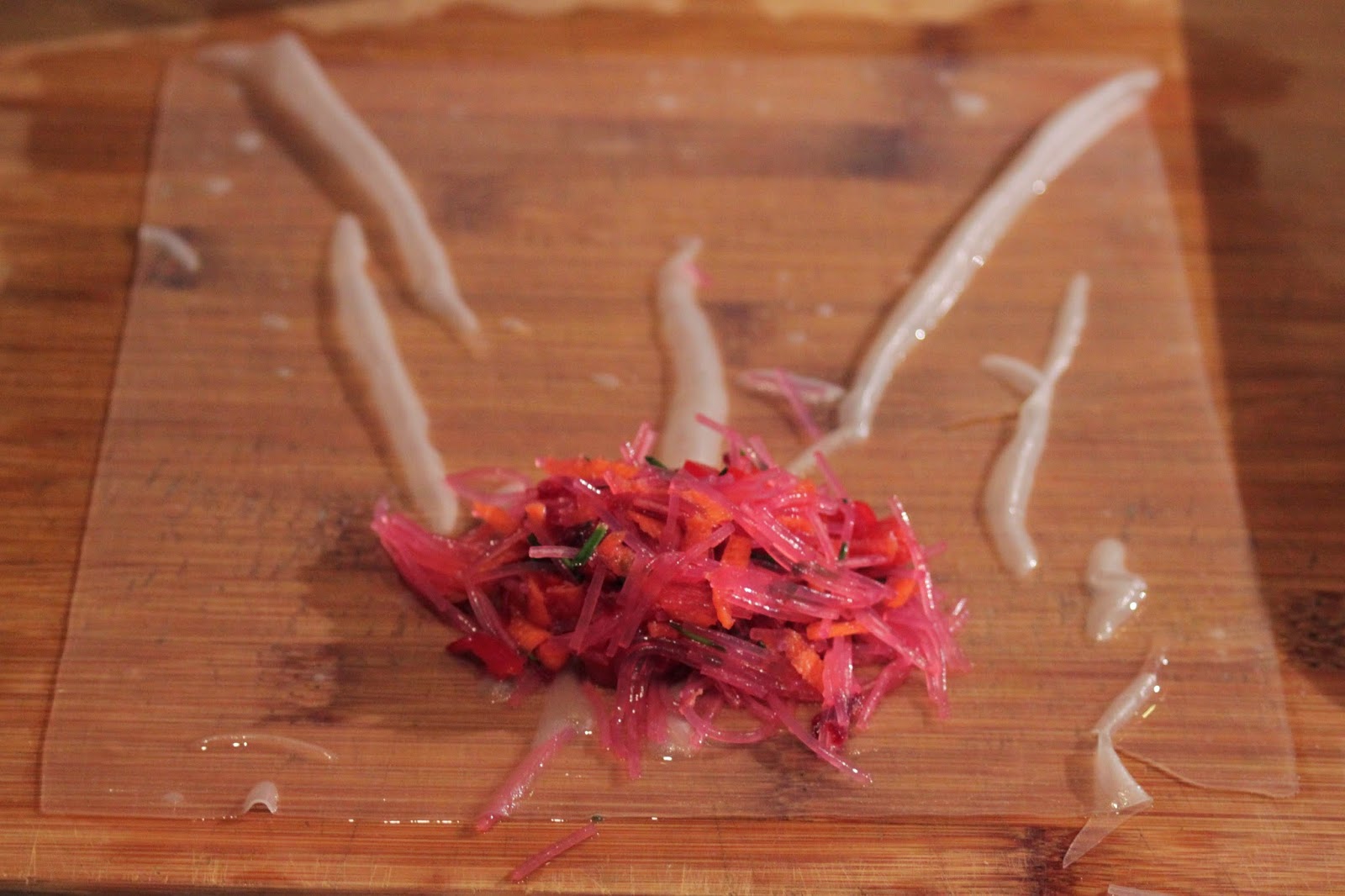


5. Roll upwards as tight as you can about 1/3 of the way.


6. Fold in the sides so that they overlap. It's important that they overlap - if not, you'll encounter some structural weakness in the middle and they'll probably rip there during frying. 


7. Now roll all the way up to the top.


8. Carry on rolling till you've exhausted your supply of vegetable mix. Place the rolls on a plate covered with a plastic bag (to avoid the rolls sticking to the plate while freezing) and place in the freezer.


9. Make a dip using one sliced green chilli, 1/2 tsp brown (or palm) sugar, a good splash of rice vinegar and an equally fine splash of soy sauce. This gives you a nice dip with a contrast of sour, sweet, salty and hot - the classic flavours of SE Asia.


10. Heat up some oil for deep frying to a medium heat. Add the spring rolls one by one and make sure to keep them from touching during the initial stages of cooking or they'll stick together. Cook for around 5-7 minutes until the rice paper has crisped up nicely. Drain on kitchen roll.


11. Serve with the dip and enjoy!


Costing:

- vermicelli and rice paper: 1 zl

- mixed veg and seasonings: 2 zl
- the rest: 1 zl
- the oil: 2 zl

Total: 6 zl

Serves: 4
Total per person: 1.5 zl


Tuesday, 8 April 2014

Cheese spread with horseradish and chives (gzik)

In some parts of Poland, they might call this "gzik". However, they'd tell me that real "gzik" is a mixture of cottage cheese, cream and spring onion and that you shouldn't even think of putting horseradish in there!

Well, I'm not Polish so I can get away with the horseradish which, for me, adds a piquant depth to the flavour. I used the finer chives instead of spring onion but I think I'll be forgiven for that at my next confession. 


"Gzik" is often served in Poland with jacket potatoes. However, I've opted for sourdough bread toast. Nice!

Cost per batch (good for around 8-10 slices of toast): 2 zl (0.48 Euro)

Less than the cost of your supermarket cheese spread, eh?

What you need:

- 100g of creamy cottage cheese
- 3 tsp of sour cream or creme fraiche
- 1 tsp horseradish sauce (horseradish whizzed up with clear vinegar)
- 2 tsp finely chopped chives
- a pinch of salt
- a good grind of black pepper

What to do:

1. Put all of the ingredients together in a bowl


2. Mix them up


3. Eat on toast


The cost:

- cottage cheese: 1.50 zl
- cream: 0.50 zl
- the rest: 0.50 zl

Total: 2 zl

Monday, 7 April 2014

Pesto with fettuccine

One of the first meals I ever made back in the glory days of my youth was pasta with pesto from a jar. Heaven!

It occurred to me recently that it could be fun and cheap to make it myself without any of the profit-boosting shenanigans that food companies tend to engage in whenever they package classic dishes for the mass market.


Pesto is simple and should consist of:

Fresh basil
Olive oil
Garlic
Salt and pepper
Parmesan cheese
Pine nuts

And nothing else.

I wanted to use pine nuts but rapidly put them back on the shelf when I noticed they cost a zillion zloties for a tiny bag. So, I'm substituting them with cashew nuts. So, the revised line-up is:

- a bowl of fresh basil leaves
- a good old slug of extra virgin olive oil
- a small clove of garlic
- salt and pepper to taste
- a very small piece of parmesan cheese
- a small handful of cashew nuts
- 250 g fettuccine to serve


Serves: 4
Cost per person: 2.50 zl (50 UK pence, 0.60 Euros, 50 Rupees)

Let's roll!

1. First of all, grind up the cashew nuts on their own in a coffee grinder.


2. Add the garlic, cheese, salt and pepper to the ground cashew nuts and grind some more.


3. Add the basil leaves and glug in some olive oil. Don't be shy. Grind down to a smooth paste.


4. Casually dress a bowl of al-dente fettuccine with this glorious homemade pesto and taste the difference!


What are the scores on the doors?

- basil: 2 zl
- Parmesan: 1 zl
- fettuccine: 6 zl
- the rest: 1 zl

Total: 10 zl
Serves: 4

Total cost per person: 2.50 zl

Sunday, 6 April 2014

Cauliflower and penne baked in a gorgonzola sauce

How much do you like the look of this on a scale from 1-10?


You likey likey? Me too, so let's get cracking!

Serves: 4
Cost per person: 2.50 zl (50 UK pence, 60 Euro cents, 26 Thai Bhat)

You'll need:

- approx. 1/3 of a cauliflower
- approx. 200g penne
- around 40g butter
- 4 tsp plain flour
- more or less 2/3 litre of milk
- a couple of handfuls of breadcrumbs
- a slice of gorgonzola
- a couple of tablespoons of grated cheese such as cheddar
- salt to taste
- a pinch of freshly grated nutmeg
- a pinch of cayenne pepper
- a good grind of black pepper

Your preparation work looks like this:


Let's go!

1. Cut the cauliflower into florets. Parboil for 5 minutes in salted water with the penne. Drain and douse with cold water to stop the cooking process. Place in an oven dish.


2. Melt the butter in a pan on low heat. 


3. Whisk in the flour


4. Add the milk gradually, whisking well every time you add a little to ensure a smooth and lumpfree result.


5. Season with a little salt, a pinch of freshly grated nutmeg (way more fragrant than the ready powdered stuff...) and a pinch of cayenne pepper (chilli powder under a different name).

6. Keep adding the milk on low heat until the sauce is not too thin and not too thick, in other words pourable without being too liquidy. Melt in the gorgonzola.

7. Add the sauce to the cauliflower and penne in the oven dish.


8. Hopefully you'll have a little of the white (let's call it béchamel) sauce left over... Add the breadcrumbs and grated cheddar to it. Mix well 


9. Take spoonfuls of this mixture and flatten between your hands as thin as you can. Put on top of the oven dish mix to form a nice topping.


10. Bake for around 20 minutes at 180 degrees or until golden brown on top and bubbling underneath.


11. Enjoy!


Costing:

- Caulifower: 2 zl
- Cheese: 2 zl
- Milk: 1.75 zl
- Penne: 2.50 zl
- Butter: 1 zl
- The rest: 0.75 zl

Total: 10 zl
Serves: 4
Per person: 2.50 zl

Saturday, 5 April 2014

Aubergine in a spicy tomato tamarind sauce (Brinjal Masala South Indian Style!)

If the mighty aubergine is the king of vegetables, then this sauce is his queen. It's spicy tanginess beautifully complements the melt-in-your mouth yumminess of the aubergine flesh in one massive symphony of flavour!


Brinjal = aubergine
Masala = mix (sauce)

You see the word "masala" a lot in Indian cuisine. It literally means "mix" and so this meaning can be transferred to a mix of spice or a mix of everything i.e. a sauce. In this case, the latter is applicable.

Various ingredients in this dish betray its South Indian origins: curry leaves, fenugreek seeds (rather than the leaves used in North Indian cooking) and tamarind (for sourness). 

I'm hearing voices right now whispering "But what if I can't find tamarind concentrate anywhere...?" and my reply is: look to the very dark sour cherries, my friend, for there you may find an equivalent.


Serves: 4
Cost per person: 3.5 zl (70 UK pence, 84 Euro cents, 119 Japanese yen)

Ingredients:

- 2 medium-large aubergines
- 1 tsp turmeric
- 1 tsp chilli powder
- 1 tsp salt plus to taste
- 2 green chillies
- 2 shallots
- 2 cloves garlic
- 1 inch ginger
- 2 medium-large tomatoes (or a tin)
- Veg oil
- 1 tsp mustard seeds
- 1/4 tsp fenugreek seeds
- 1 tsp cumin seeds
- good amount of curry leaves
- 1 tsp coriander powder
- 1/2 tsp tamarind concentrate dissolved in a small glass of hot water

Hit me!

1. Make a "batter" of the turmeric, chilli powder and salt by adding a little water to them in a bowl.

2. Cut up the aubergines fairly chunky and cover with the "batter" from stage 1.


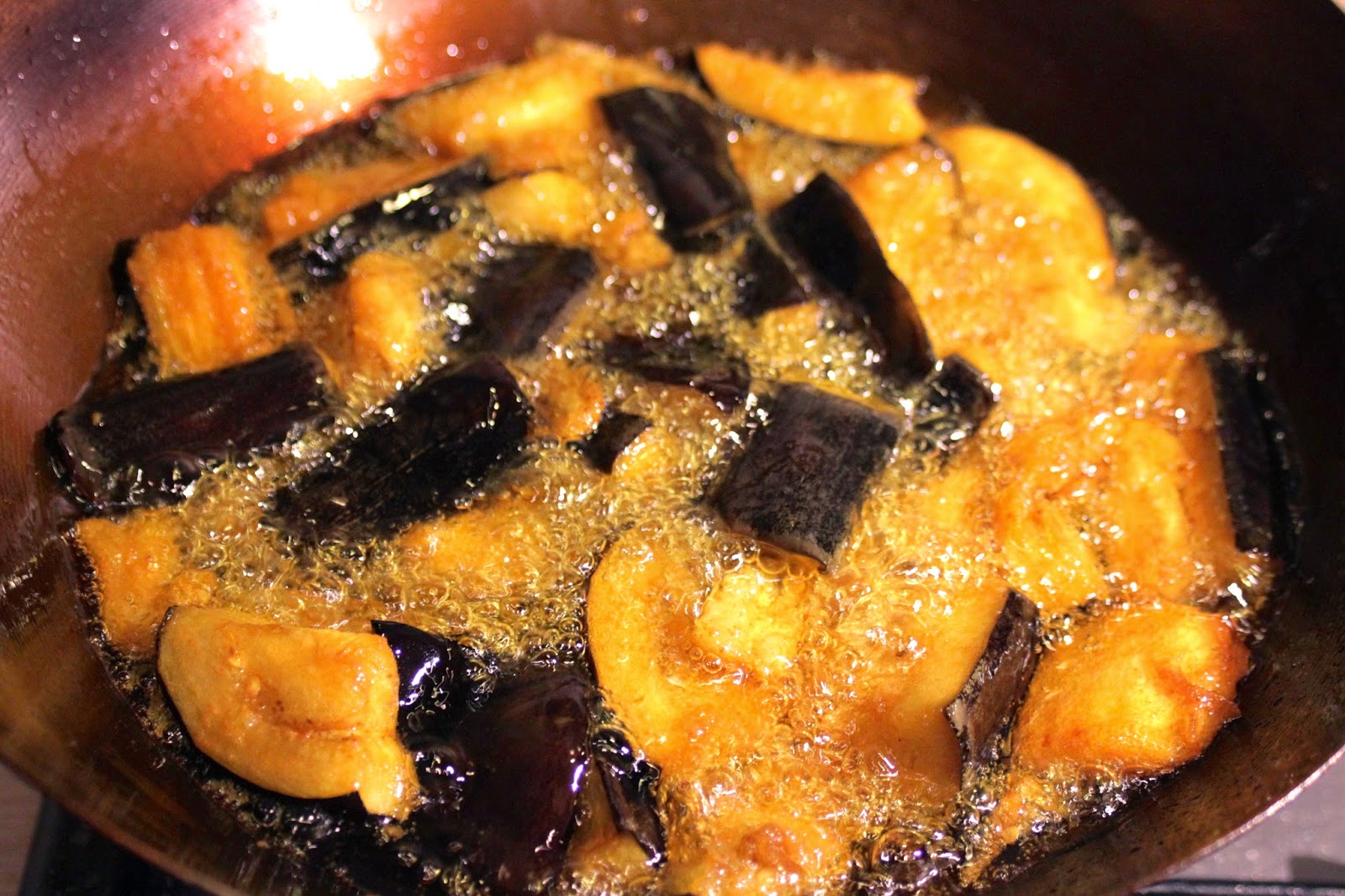
3. Get some oil really hot for deep frying. Add the aubergines and cook till reduced to half size and starting to brown (approx. 10 mins). Then remove and allow to drain in a sieve placed inside a bowl. The bowl will catch some of the oil dripping out and this oil can be used as a base for stage 9. If deep frying freaks you out, you can shallow fry instead (skip the "batter", though, and add a little turmeric, salt and chilli to the pan as the aubergines shallow fry instead).


4. Meanwhile.... Whizz up the green chillies, shallots, garlic and ginger in a grinder to make a smooth paste.


5. Also prep the whole spices


6. Prep the tomatoes by removing the skins and then blending into a puree. If tomatoes are out of season and you're faced with the hard force-grown supermarket classics, leave them  in the shop where they belong and get a tin instead.

7. Prep the tamarind by dissolving 1/2 tsp of concentrate in a small glass of hot water.

8. Ok, we're all prepped and by now the aubergines will have been taken out the oil and drained into a bowl. Some oil will have gathered at the bottom of this bowl and you'll be using this now to fry out the paste from stage 4. Discard the oil from the pan.

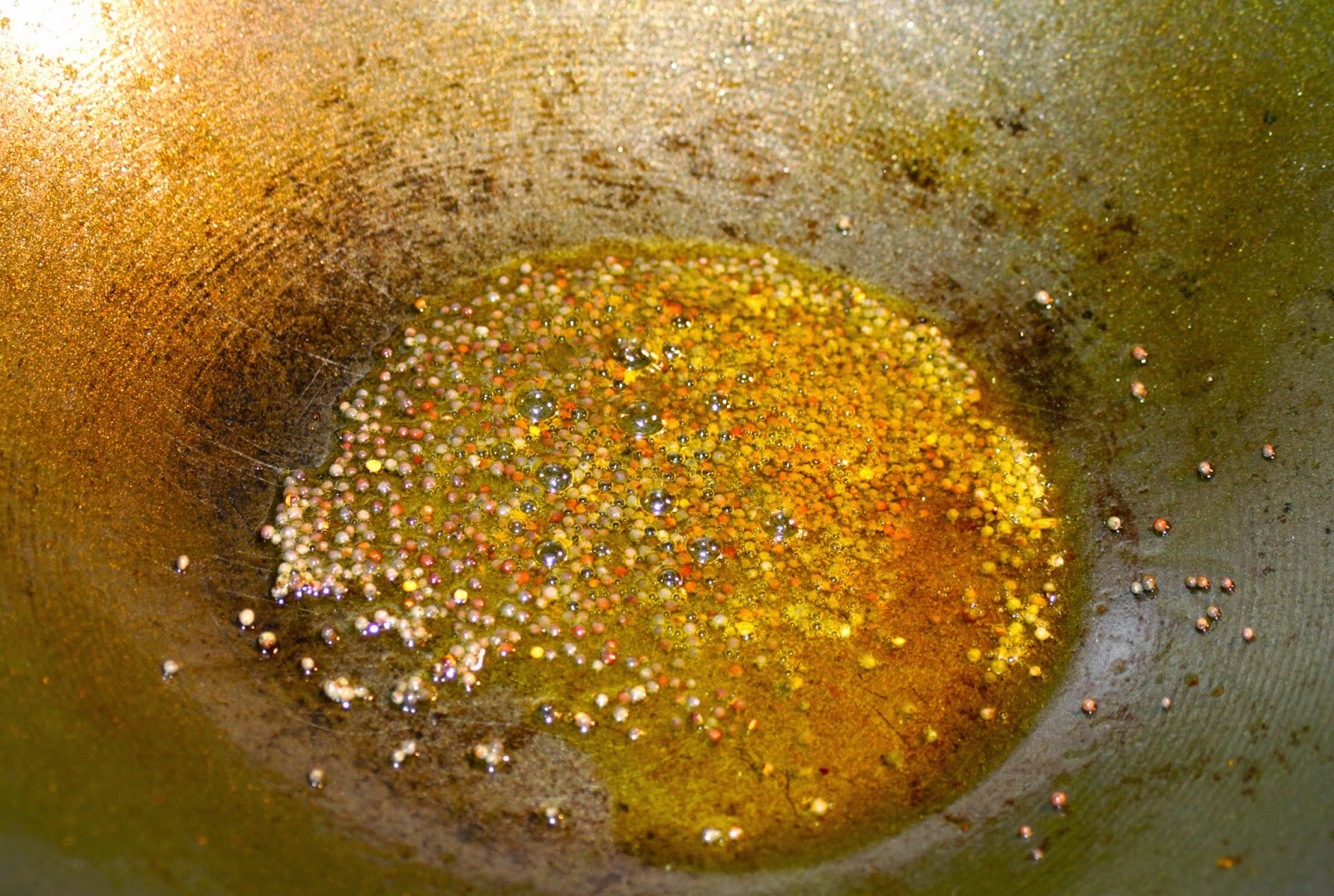
9. Oil in. Heat. Mustard seeds. Crackle


10. Fenugreek seeds


11. Cumin seeds. Paste.


12. Curry leaves. Cook out the paste for around 5 minutes. Add more oil if necessary. 


13. Tomatoes in.


14. Coriander powder. Cook through on low for around 5 minutes. Taste. Check the seasoning. Add a little more salt or chilli if necessary. If too acidic or bitter, sprinkle in a little brown sugar.


15. Tamarind in.


16. Get the aubergines back in. Stir through and kill the heat.


17. Serve with rice and whatever else tickles your fancy!


The costing:

- aubergine: 8 zl
- tomatoes: 2 zl
- rice: 1.60 zl
- the rest: 2.40 zl

Total: 14 zl
Serves: 4
Per person: 3.5 zl